
Forum Replies Created
-
AuthorPosts
-
 BRONZE Member
Hi edo,
That is actually very useful news! If cooling down PCB32 brings the sound back, then the problem now looks clearly thermal and the TDA1305T itself is much less likely to be the root cause.
My first suspects would be:
- voltage regulator(s) on PCB32,
- electrolytic capacitors around the DAC / audio supply section,
- local decoupling capacitors,
- mute / output stage transistors,
- bad solder joints or hairline cracks,
- possibly a clock/buffer component around the DAC section.
Suggested steps:
I would not cool the whole board anymore, but use freeze spray very locally, component by component.
Start with the power regulators and capacitors around the DAC/audio section, then the muting/output stage components, and finally any logic/clock components feeding the DAC.
Also, it may be worth checking the DAC supply rails again with an oscilloscope, not only DC voltage. A regulator or capacitor can still show 5V DC while having noise/ripple or instability when warm.
Location: The Netherlands
Favourite Product: BeoSound 9000
My B&O Icons:

Good luck!
🤞🏻
Location: The Netherlands
Favourite Product: BeoSound 9000
My B&O Icons:
That sounds like a reasonable approach.
As far as I know, there are no known Beosound 9000-specific versions of the TDA1305T. The TDA1305T is a standard Philips DAC, used in many different audio products of that era.
Therefore, if:
- the donor DAC board is working correctly,
- the donor TDA1305T is healthy,
- the IC is removed without damage,
- and it is soldered correctly onto the BS9000 board,
then I would expect it to work in the Beosound 9000 as well.
What makes your case particularly interesting is that the replacement will also act as a diagnostic test.
If the donor TDA1305T works normally and the fault disappears, that would strongly confirm the original DAC was defective.
If the donor TDA1305T shows exactly the same behaviour as the original IC, then I would start to suspect that something else around the DAC stage may still be contributing to the problem.
In any case, using a known-working donor IC from a complete DAC board gives a much higher level of confidence than buying loose ICs from unknown marketplace sources.
Please keep us updated on the result after replacing the TDA1305T with the donor board one.
Location: The Netherlands
Favourite Product: BeoSound 9000
My B&O Icons:
I think purchasing the complete DAC board was probably the best decision at this point.
After all the measurements, the diagnosis now seems much clearer:
– digital data signals remain present,
– clocks remain present,
– supply voltages remain stable,
– mute line does not change,
– CD mechanism continues operating correctly,
– but the analog signal disappears directly at the DAC outputs.That combination now strongly points to an internal DAC failure.
Also, the fact that one replacement IC worked briefly before failing could indeed suggest reclaimed, marginal or counterfeit parts.
Using a complete donor DAC board is a much safer approach because it also eliminates possible uncertainties regarding soldering, surrounding components and PCB-related issues.
Please keep us updated — this has become a very interesting diagnostic case.
Location: The Netherlands
Favourite Product: BeoSound 9000
My B&O Icons:
Thank you, that is a very important additional test.
If I understand correctly:
– BCK remains OK
– WS remains OK
– DATA remains OK
– VDDA / VDDD / VDDO remain stable at 5V
– MSUB remains at 5V
– and the analog audio signal disappears directly at the output pins of the TDA1305TThen I agree: this makes the TDA1305T itself the most likely cause.
At this point the problem is probably not the CD mechanism, not the digital signal going into the DAC, not the supply voltage and not the mute line.
The difficult part is finding a trustworthy replacement. Since the TDA1305T is an old Philips/NXP DAC, I would be very careful with Ebay or AliExpress parts. They may be reclaimed, relabelled or fake, even if they look correct.
I would try:
– NXP authorized distributor network
– Rochester Electronics
– professional obsolete component suppliers with traceability
– or possibly a donor board from another known-working unitPersonally, I would avoid buying more “new and original” ICs from unknown marketplace sellers unless they can provide proper traceability.
Location: The Netherlands
Favourite Product: BeoSound 9000
My B&O Icons:
Thank you, that is useful information.
If BCK, WS and DATA remain OK, and VDDA / VDDD / VDDO all remain stable at 5V before and after the audio disappears, then the digital input signals and supply voltages to the TDA1305T seem to be present.
That does make the DAC a stronger suspect than before.
However, I think there is still one very important measurement missing:
Is the analog audio signal still present directly at the output pins of the TDA1305T after the sound disappears?
If the analog output from the DAC disappears while BCK / WS / DATA and all 5V supplies remain OK, then I would agree that the DAC itself becomes very likely.
But if the analog signal is still present at the DAC output pins, then the problem must be after the DAC, for example in the muting circuit, output stage or coupling components.
So in my opinion the next decisive test is to check the analog output directly on the DAC pins before and after the fault occurs.
Let me know the outcome!
Location: The Netherlands
Favourite Product: BeoSound 9000
My B&O Icons:
Thank you, this clarification is useful. What I now think is:
The fact that the original IC always returns to exactly the original behaviour probably means:
– the board itself was not permanently damaged during the IC replacements,
– the original fault is still present in the same signal chain,
– and the Ebay IC’s may indeed be questionable, but they still do not automatically prove that the original DAC IC is the root cause.The 3 different behaviours with the 3 IC’s are interesting:
– original IC → sound disappears after 1-2 minutes,
– replacement IC #1 → intermittent sound after ~30 seconds, then mute,
– replacement IC #2 → no sound at all.This could mean:
– the replacement IC’s are fake / reclaimed / defective,
– or they are more sensitive to an existing surrounding circuit problem.At this point, I personally would not continue buying more TDA1305T IC’s before doing more measurements around the original IC.
I think the important next diagnostic step is determining:
Does the audio already disappear directly at the analog output pins of the DAC, or only later in the muting/output stage?That would help confirm whether the DAC itself is really failing.
I would suggest checking:
– DAC supply voltages before and after audio disappears,
– BCK / LRCK / DATA signals,
– mute line / muting circuit,
– analog output directly on the DAC pins,
– freeze spray / thermal testing on the DAC and surrounding components.To me this still feels more like a surrounding circuit or thermal issue than a confirmed pure DAC failure.
Location: The Netherlands
Favourite Product: BeoSound 9000
My B&O Icons:
Thank you, that information helps.
Since it is a MK3, at least we know the technician is working with the correct service manual and the correct DAC type (TDA1305T).
However, the behaviour still does not fully convince me that the DAC IC itself is the primary problem.
The fact that:
- the CD continues spinning correctly,
- timing continues normally,
- and the audio first becomes intermittent before disappearing,
still sounds more like a thermal or surrounding circuit issue to me.
Possible areas worth checking:
- power supply stability around the DAC/audio section,
- voltage regulators,
- electrolytic capacitors,
- mute circuit/transistors,
- solder joints or hairline cracks,
- temperature-sensitive components around the DAC stage.
Especially because the failure develops after some operating time.
A useful diagnostic step could be freeze spray / controlled heat testing around the DAC and surrounding circuitry to see if the behaviour changes immediately.
Questions
- Does the sound always disappear after roughly the same amount of time?
- And does it return again after the unit cools down?
Location: The Netherlands
Favourite Product: BeoSound 9000
My B&O Icons:
I am not fully convinced yet that the TDA1305T itself is the root cause.
The fact that the CD keeps spinning and timing continues, while only the audio disappears after 1-2 minutes, could also point to a thermal issue, power supply instability, muting circuit, soldering problem or an issue around the DAC/output stage.
Also, the different behaviour with the replacement IC’s does not automatically prove they are fake.
One important question:
Which version of the Beosound 9000 is this exactly? MK1, MK2 or MK3?There are differences between revisions/boards and that may matter here.
Do you know:
– the exact type / MK version?
– whether the service manual matches this unit?
– if the supply voltages around the DAC were measured when the sound disappears?
– if the mute signal changes state when the audio drops out?To me this still sounds more like a surrounding circuit issue than a pure DAC failure.
Location: The Netherlands
Favourite Product: BeoSound 9000
My B&O Icons:
Thank you very much for sharing your experience. I haven’t had the opportunity to compare all the BeoGram models, and experience their differences.
So, this information is welcome!
Location: The Netherlands
Favourite Product: BeoSound 9000
My B&O Icons:
Interesting comment.
How would you rate the BeoGram 4000 series, compared to other (later) linear tracking turntables, and radial tracking turntables?
Location: The Netherlands
Favourite Product: BeoSound 9000
My B&O Icons:
A warm welcome to you Michael !
Great you got the virus too. And by the way, your story brings back to me the ‘triangle of top designers’.
- Braun design s became famous because of (the great) Dieter Rams.
- Apple’s top designer Jonathan Ivy was inspired by the designs of Dieter Rams. There’s a famous list of Apple products derived from Dieter Rams’ / Braun designs: https://sl1nk.com/fVgIa
- Jonathan Ivy also was inspired by the B&O designs, especially with aluminum, which is obviously recognisable in most Apple products.
So, going from loving Braun to loving B&O is quite logical. Enjoy it!
Location: The Netherlands
Favourite Product: BeoSound 9000
My B&O Icons:
Dear Daphne,
I get that.
Your Beolab 8000’s were manufactured in 2002.
With this serial number, they are MK1. (serial number 1699 2475 and above are MK2)Best,
Location: The Netherlands
Favourite Product: BeoSound 9000
My B&O Icons:
I took my BeoGram 1000 out of storage to check how my platter gets disassembled.
With my BeoGram 1000 it’s a 2 step:
- Remove the C-clip to remove the inner (plastic) plate with the strobe markings.
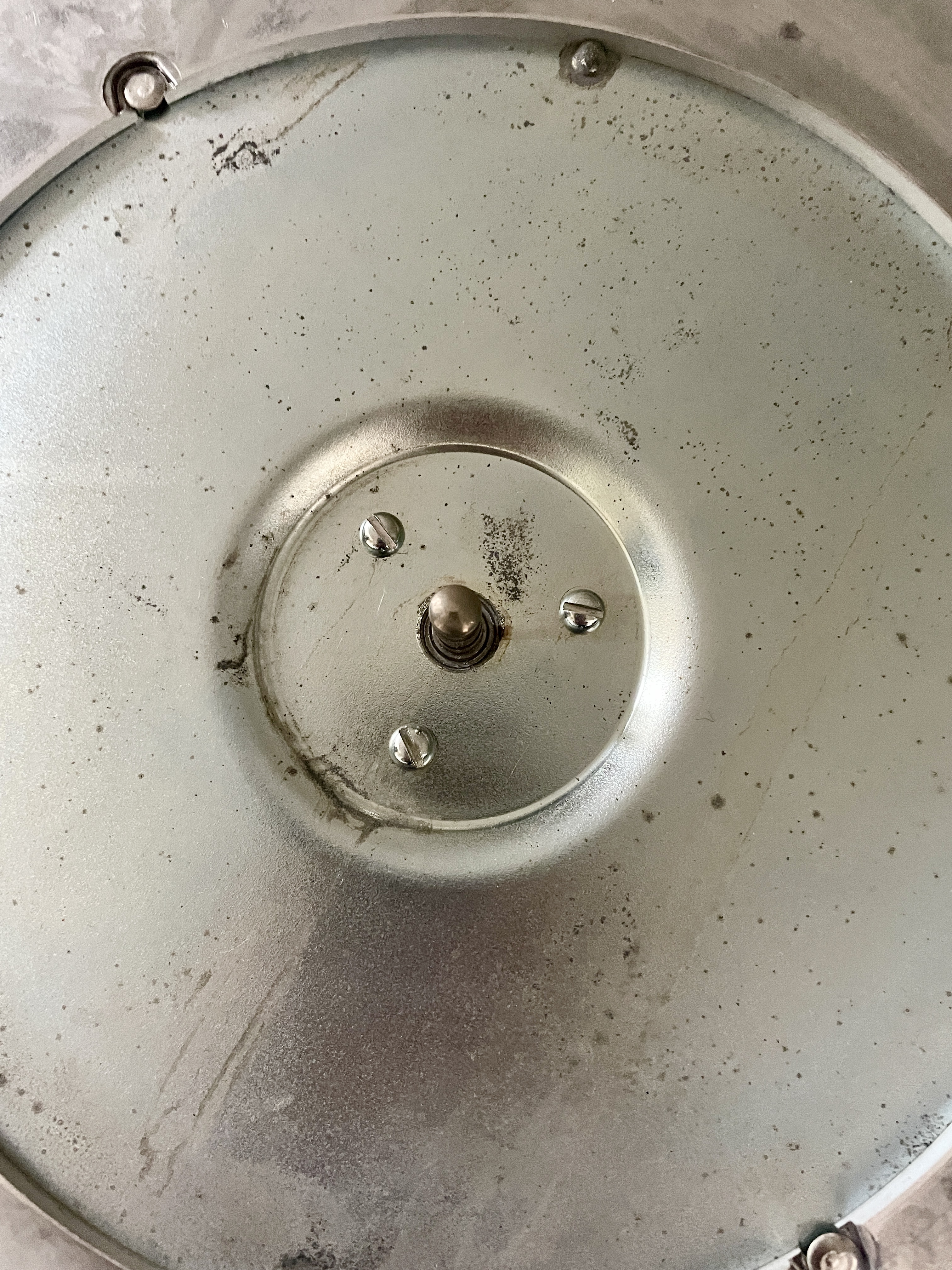
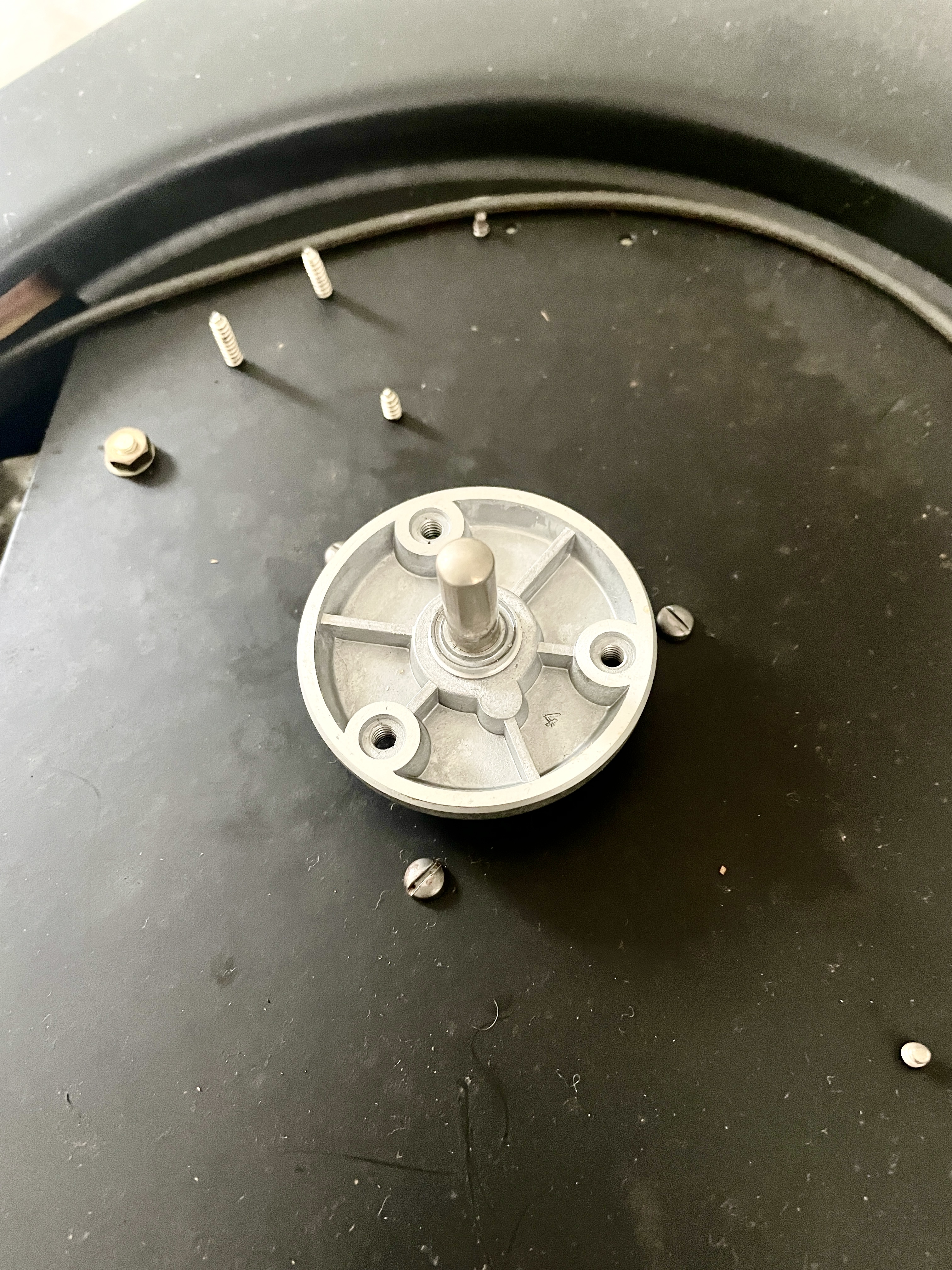
- Remove 3 screws on the main plate, to lift it from it’s holder (see the 2 pictures).
In your case, the 3 screws are rivets. So lifting the platter won’t work the way it does for me.
Though:
- If you need to check the suspension, the platter doesn’t have to be removed. For suspension you need to get the acces via the bottom of the plinth.
- If you need to replace the driving belt, there are ways (not the easiest ones) to do that with the platter in its normal position (for instance as described here after point 11)
- If you need to get the platter out of its way: since it seems to be attached to an assembly including the platter axes, there should be a way to release this axes from the shaft. But this can only be done from the bottom side.


Location: The Netherlands
Favourite Product: BeoSound 9000
My B&O Icons:
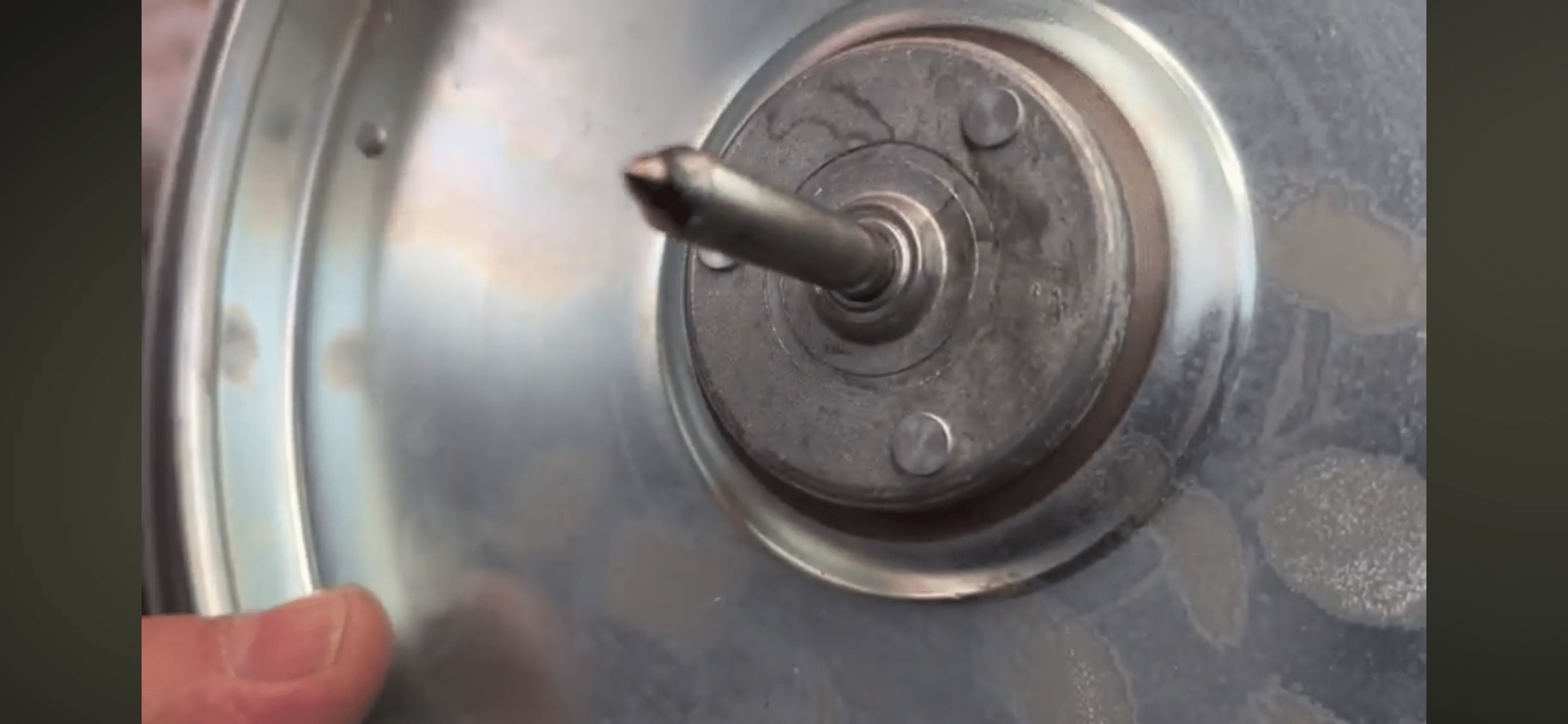
Are you able to rotate the platter, or is it stuck?
For your information, the platter you are trying to remove, looks like this from the bottom side:
Location: The Netherlands
Favourite Product: BeoSound 9000
My B&O Icons:
If I remember well, you should be able to lift the platter up/out.
Location: The Netherlands
Favourite Product: BeoSound 9000
My B&O Icons:
I had the same the first time. But look very closely.
There is a C-clip that sits on the axel-pin in the middle (seen from the top). Remove that, but be careful that it doesn’t jump away.
When removed, you can lift the inner disc with the strobe markings.
Location: The Netherlands
Favourite Product: BeoSound 9000
My B&O Icons:
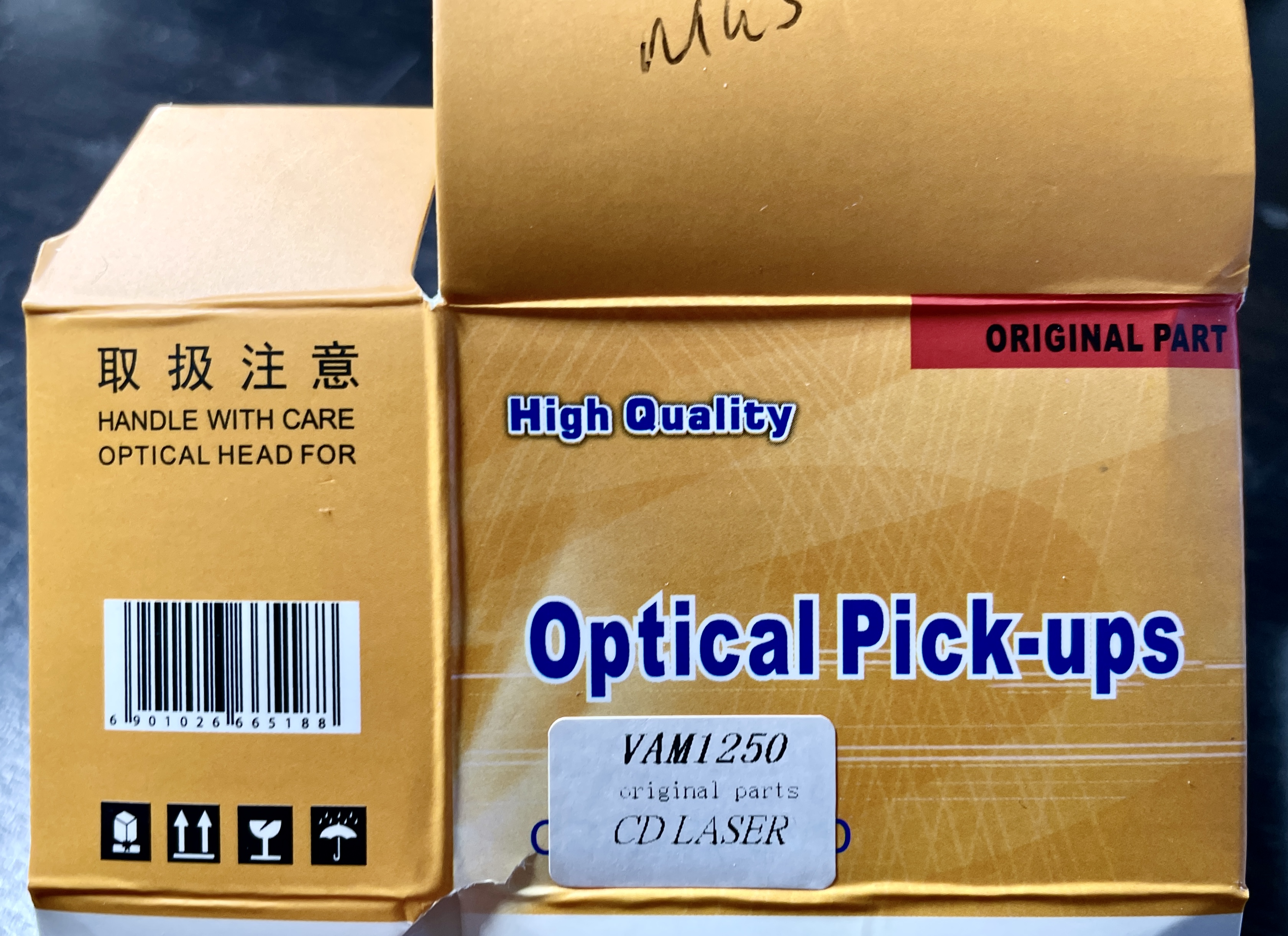
9 April 2025 at 16:18 in reply to: VAM1250 for BeoSound 9000 MK3: who knows a reliable source to buy > SOLVED #65043Interestingly, the item on eBay mentions ‘VAM1250/21′ and the main picture shows the exact same box (and VAM1250’ on the white sticker on the box) as the unit I got from Keith Saunders.
If I would have to get one now, I would try this.
(I am not guaranteeing for you, it’s always your own risk)
Location: The Netherlands
Favourite Product: BeoSound 9000
My B&O Icons:
9 April 2025 at 10:55 in reply to: VAM1250 for BeoSound 9000 MK3: who knows a reliable source to buy > SOLVED #65041Very sorry to hear the VAM1254 does not work.
Though, even if they look almost the same, they are not. I read a lot of info about OPU’s. The VAM1250/21 that you need belongs to the ‘CDM-12 Pro’ family of OPU’s. Others are: VAM1204, VAM1205, VAM1206, VAM1252 and VAM1254. They all share comparable specifications, which also means there are differences. Unfortunately, you just found out about that.
The OPU you have in your BeoSound is a VAM1250/21, like I had. I was lucky to find one with the help of Keith Saunders. Although it is a VAM1250 (not /21), I know this one works.
You can try to contact Keith, but if I remember weel, he sent his last unit to me.
I made a quick check on eBay and found this one: https://www.ebay.com/itm/363230316872
It is a VAM1250, but I don’t know how reliable the advertisement/advertiser is. Maybe you can try to contact them.
Location: The Netherlands
Favourite Product: BeoSound 9000
My B&O Icons:
4 April 2025 at 08:03 in reply to: VAM1250 for BeoSound 9000 MK3: who knows a reliable source to buy > SOLVED #64933Thanks for adding the picture. It confirms that your laser unit (in the MK2) is exactly the same, as mine (in a MK3).
This type is a little bit hard to find. I made a picture of the packaging on my replacement laser unit (see below). It does not contain any manufacturer/supplier specific text unfortunately. ( The Chinese characters mean ‘Chinese New Year’s Eve) And the barcode number is not leading to specific and right product or manufacturer information.
Though, the looks of the packaging might help you to find the right laser unit.

Location: The Netherlands
Favourite Product: BeoSound 9000
My B&O Icons:
-
AuthorPosts