
Forum Replies Created
-
AuthorPosts
-
 RegenpakBRONZE Member
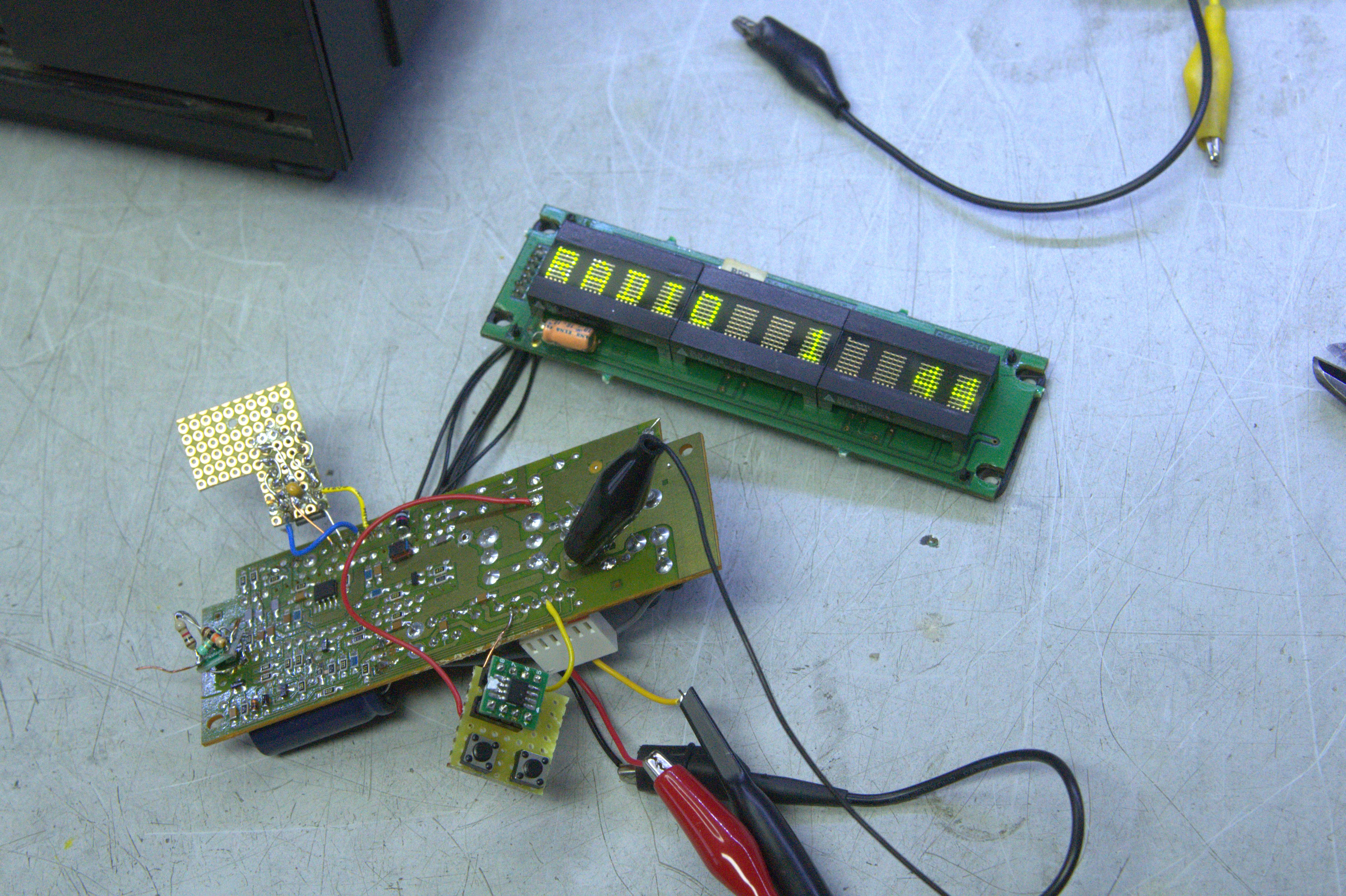
Epilogue. The zener and transistor in the BC were tested and found good. They were placed back and lo and behold! The display in the Penta worked! There was no difference in the data that came over the Beolink as seen on the display in the Penta. The displays that were with me have been sent back to their owner. They now all work. No idea what would have caused this enigmatic behavior. Maybe shifting ley lines?
RegenpakBRONZE MemberMore red herrings. I thought the jitter was an important clue so I wrote code (attached) to produce a jittery command based on a Saleae recording. The displays on my workbench happily displayed the data from the command. So half a day spent on producing code for nought. Then I realized that my friend uses the Penta transformer to power the displays and I use a DC PSU. So I hooked up a similar 10 VAC transformer and was rewarded with a fully operative display. I’m running out of inspiration what to look for.
On the plus side: I learned that the Beothingies send the device data (RADIO preset, CD track) and volume data separately. And if the volume data is not known the display will show nothing. Maybe that’s the reason my friend’s display is dud. I will ask him to change volume and send the recordings. In my code I cater for two buttons, SW1 sends CD 2 42 (in two commands) and SW2 sends RADIO 7 (once command with jitter), then RADIO 2 (one command but clean) and finally RADIO 8 42 (two commands). When I switch on, the display shows nothing until I get to the third command. The CD shows right away. But because it sets the volume to 42 the default value of 44 is not shown.
Attachments:
You must be logged in to view attached files.RegenpakBRONZE MemberWell, I thought I was on to something. I changed the oscillator timing on my PIC Beo command generator so the timing got slower. I started at 1.80 ms (spec: 1.56 ms) and did not get a display. At 1.62 ms the display was back. At 1.66 ms it was flakey. At poweron it would not display but after some time it started to display some commands. Then I realized that to make life easier on myself and to be able to dial in the cutout point I could just replace the display’s crystal with an external reference source, a Marconi 2023 signal generator. But it was still inconclusive, I had to change to lower than 11.11 MHz or higher than 12.47 MHz to get an intermittent response. I then looked closer to the Saleae recording of the Beocenter 9k5 data and found that there was significant jitter in the timing. It varied from 1.579 to 1.585 ms. Certainly slower than 1.56 ms but referred to the 80C52 clock only (1.585/1.56)*12=12.19 MHz which is nowhere near 12.47 MHz.
Unfortunately the BC is not on my workbench. I can ask its owner to replace D6 but I doubt that that causes the jitter in the data. It is simply a clamping zener diode that clamps to 12 V. The dataline is only 5 V. I will also look at the data input of the 80C52 (pin#36) because of the unresponsive display at poweron. BTW- there is one MK2 display (with orange LEDs) and that works just fine. Another MK3 refuses. Weird…
RegenpakBRONZE MemberWith the help of a cheapo logic analyzer I finally managed to get readings from the affected Beocenter (which happens to be a 9500). It only sends single bursts whereas the display only reacts on two bursts. The protocol is a bit tricky to decode so I only record the timing of the pulses. This also makes it much easier to program the burst (“riedel” in Dutch) in my PIC. My 2k5 sends:
RADIO 8 44
1151232123213123221313212222223122222222313212222241
11512322132221222231321222222222312222231222222222241and the 9k5:
(radio)
115123221322212222313122222222222222222222341The latter is only one command which is also much shorter. No idea why that is. Maybe it should also send parameters (program, volume) for the display to show it.
There have been efforts to decode the Beocommands but these seem incomplete. Will do some more testing.
RegenpakBRONZE MemberThe chance of all four displays sharing the same failure are infinitesimal. With the help of a Beocenter 2k5 I loaned from a friend I fed one display a beolink databurst and lo and behold the correct text appeared on the display! I even got my PIC code to send a valid command to the display. Now all we must find out is why the Beocenter 9k fails to produce the correct data. To be continued…
 RegenpakBRONZE Member
I just realized something. The AUDIO/!VIDEO input is HIGH to unblank the display. When LOW in case of home theater it blanks the display but if the input has gone phut and always reads LOW for the firmware inside the 80C52 the display will never get unblanked. So if that is actually the case all four units are toast. There is current flowing out of pin#25 but being TTL that is always the case.
To troubleshoot further I will do some supply current analysis. If there is any processing going on this will show in the current going into the VCC pin #40.
-
AuthorPosts