Beogram 8002 repair

25 replies

Hello all,

I have had a BG8002 as part  of my 8000 system for about 4 years now I think. Unfortunately it started acting up some time ago: not starting, showing 33 as soon as I plugged it in, just erratic behaviour pointing to the common problems of bad caps and or connections.

Some caps were already replaced by the former (very knowledgable) owner. I replaced the rest of the old caps. I resoldered and cleaned the connectors on main and processor PCB and every other bad looking joint. Worked fine for maybe a day and then went wonky again!

Resoldered lots of connectors again, replaced 5V regulator as it gave 4,8V instead of 5V. worked for a day and went whacko again!

Replaced the processor IC socket. Worked for a few days and then the bad stuff started over again.

I suspected the 'bare wire into socket' connectors of the processor can and keyboard-to-main pcb connectors. Replaced them with more sturdy new connectors. Again the BG worked fine for a few tries and... then the erratic stuff started over.

I'm going slightly mad now. What shall I do? Inspection under magnifying glass did not show any broken traces but could have missed something.

My differential diagnosis:

- bad soldering or broken trace or shorted solderings somewhere that I have missed

- bad 4n7 ceramic on the processor board

- bad microprocessor IC

My questions:

- How can I check if the processor is fried? If this is the case any soldering will be for nothing.

- What should be my next step? I've opened the BG up one too many time and can't really see clearly anymore.

Any suggestions or moral support would be greatly appreciated!

Location: Netherlands
You will have to ask Martin for sure but in the several Beogram 8002 turntables I have restored the processor hasn't been a problem. If you replaced everything else and you couldn't get anything to function (and power supply is verified as working), then maybe the processor would be suspect. However, I think I understand you saying that the turntable will function properly at times so that doesn't sound like a processor problem to me. If it was fried nothing would work. You will probably need to set the board and control panel in a position to function without installing them into the turntable chassis in order to trouble shoot some signals. For instance, when it won't start, you will be able to probe signals and isolate where the fault is originating. if you can post some detailed pictures of the work you have done so far, other members that have done these restorations can double check your work. I know on one of my Beogram 8000 restorations recently, Beobuddy was reviewing my work and found I had a capacitor connected wrong. It's very helpful to have a second set of eyes look at your work.

One question to clarify the symptoms - Every time you do some work on it and then try it out you say it works correctly for a while, then starts failing. How long does that take before failures occur?  Also, if you unplug the turntable and let it sit for a while (few hours to a day) after it has started failing, will it work for a while again when you plug it back in? I ask that to determine if the problem could be temperature related. Maybe there is some hidden, cold solder joint somewhere that is causing the havoc. Another thing to consider are the actual connectors. You resoldered the board connectors but the wire harness plugs could have a loose connection somewhere. Those can cause all sorts of strange behavior. I had a Beomaster 8000 problem before where I started down the path of suspecting some transistors on a board but the problem was actually a bad pin in one of the wire harness plugs. It was an intermittent type problem so it wasn't easy to find. A lot of the time it turns out to be a simple low tech problem like that.

-sonavor

Hi Sonavor, thanks for the answer!

The time it takes to fail differs greatly, it doesnt get better when it has been standing.

Unfortunately I haven't had time to work with the BG till today. I've been measuring and reading your BG8002 thread.

The problem now is the table turns on, shows the red dot, the buttons work, but won't start the TT, just change the display. No response from platter or arm.

When I measure pin 4 of connector 6 (on/off signal) I get 0.736V when off, it becomes 0.711 when on.

The 5V is present. There is on pin 10 of P2 23.5V, on pin 8 there is 23.6V. There is -23.5V on base and emitter of TR19, 0V on the collector so the voltages from the rectifier are there.

The base of TR6 has 0.64V. Its collector has 0.100V.

The collector of TR21 has 0.053V when on,  0.100V when off.

TR23 had on its base 0.100V. On its collector 0.53 when off, 0.100 when on.

Comparing to your schematic and measurements I'd say TR21 is suspect. What do you think?


Location: Netherlands

Examine the solder joints on those transistors. If you suspect TR21, desolder it and measure it outside the circuit. Before you do that though...what do you get for DC voltages coming out of the power supply circuit?  Do you have +15 VDC across C28 and -15 VDC at the junction of D26 anode and TR19 collector?  Measure those voltages for "Play" and for "Stop".

sonavor

The +/- 15V are not there whether play or stop, something is blocking the power supply regulators from coming on.

I tested TR21 in my transistor tester, B=224, Vf=635 which seems fine to me. TR6 and TR19 also tested good. I could test the others later.

I measured +5V on P6-3 when on and +4.9V when off, the pin connected to 'reset' on the processor. Should this pin be 5V under all circumstances?

Location: Netherlands

It has been quite a while since I went through the power supply signals so I would need to go through it again to properly diagnose your problem.

You said the standby light illuminates and the control buttons work. How do you know they work? If the unit won't turn on it sounds like the buttons may not be working. Have you double checked that the control panel cable hasn't come loose out of the main board (push in) connector it goes to? Also make sure none of those wires were bent or went into the wrong socket.

When you monitor P2-2, does it always have +5 VDC ?  When you monitor the base of TR21, do you see it switch from a low value to around +5 when you operate the turntable to Play?  You might try disconnecting the connectors from the main board, like the platter (P4 I believe), and see if you get +-15 DC power to come up.

sonavor

Mostly when I plug the BG in the display shows the . and when I press play it says 33 (not 33.33, only the first two digits show). This is what I call 'on'. I can change it to 45 with the 45 button. No respronse from the << or >> or other buttons but this makes me think the buttons are connected.

After a while the display dims out. sometimes when I plug it in the display has . . . displayed. There doesn't seem to be a pattern.

I replaced the push in connector of the buttons with a normal connector because the wires were very bent and wouldn't stay in.

The 5V is always present on P2-2 and P6-1 (it's actually 5V at the regulator, 4.98V at the pins)

Disconnecting all plugs except P2 doesn't make a difference in the +/-15V supply coming on.

TR21 switches from 0.74 when 'on' to 0.72 when 'off'.

Thanks a lot for thinking with me Sonavor! Your website was a great help to me when I replaced the caps on my MS150.2's.


Location: Netherlands

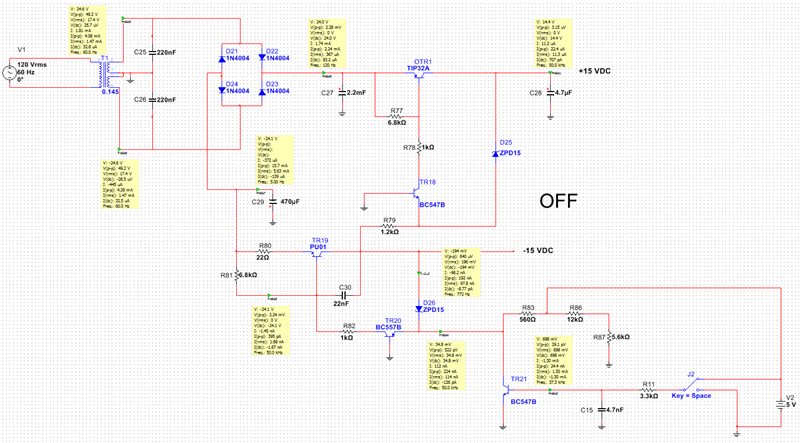
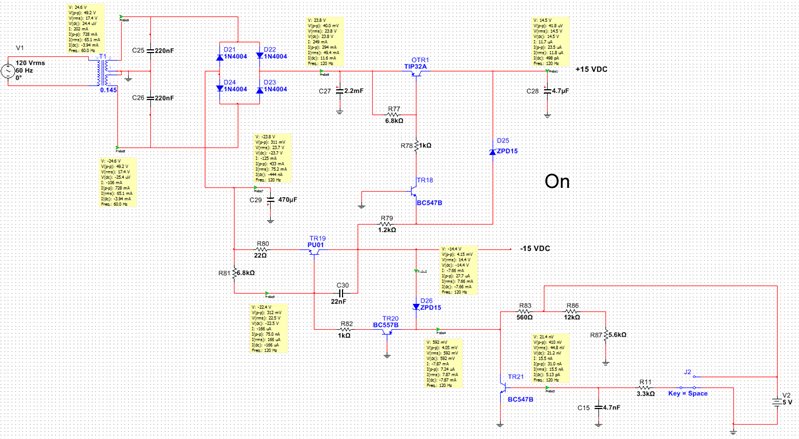
I am happy to try and help. I dug up my old notes on the Beogram 8002 and I had a simulation circuit I did for the +-15 VDC power. If my simulation is correct, here is what the "On" condition is for the +-15 VDC.

Here is the "Off" condition.

As you can see, your P6-4 (base of TR21) always at 0.7 VDC keeps the +-15 VDC power supplies off. My simulation isn't accurately showing the +15 VDC in the "Off" condition because the capacitor, C28, actually should have a load so it discharges when power is turned off. I reworked my simulation below.

With the P6-4 disconnected, what do you measure on the processor side?

sonavor

or
BeoWorld Gold Membership card
Join BeoWorld

Register to access the forums, reference material, and exclusive member benefits — including our monthly prize draw.

Become a Member

December 2026 Prize Draw

Gold Members Only

As a Gold member you're automatically entered into our exclusive prize draw — your chance to win iconic Bang & Olufsen products. A unique benefit of BeoWorld Gold membership, every draw brings a new opportunity to win something special.